Your Launch Date Isn't the Finish Line – It's Where the Real Problems Start.
You hit design freeze. DV testing passed. The clinical units performed. Everyone in the room is ready to call it done and start counting units shipped.
Here’s the question nobody asks in that room: did you validate the process that built those units, or did you just validate the units’ design?
Those are not the same thing. And the gap between them is where commercialization plans quietly fall apart.
I’ve watched teams walk into launch with real engineering discipline behind the product and almost none behind the process that makes it. Why does this happen? Not because companies don’t care about manufacturing. Because commercialization planning has blind spots, and they’re the same ones every time.
Pitfall 1: You budgeted for the product. You didn't budget for the process.
Process development gets treated as something that happens by default, not something you plan for. The build process used for DV testing, demo units, and the clinical batch becomes the plan. Nobody asks whether it can run at commercial volume, because at first, when volumes are low, it doesn’t need to.
Low-volume manufacturing hides everything. A skilled operator builds ten units by hand, making small adjustments as they go, and every unit passes.
Scale that same process to thousands of units per month, run by operators who weren’t in the room when it was developed, and the cracks show up in specific, predictable ways. A new lot of adhesive cures ten seconds slower than the one you validated on, and nobody notices until bond strength starts drifting toward the low side of the process window. A fixture that worked fine at bench-top pace creates a stack-up tolerance issue once three shifts run it back-to-back. An edge case that appeared once during DV – dismissed as an outlier – turns out to be a real failure mode that shows up every few hundred units.
The process didn’t get worse. It just stopped being small enough to hide its own variation.
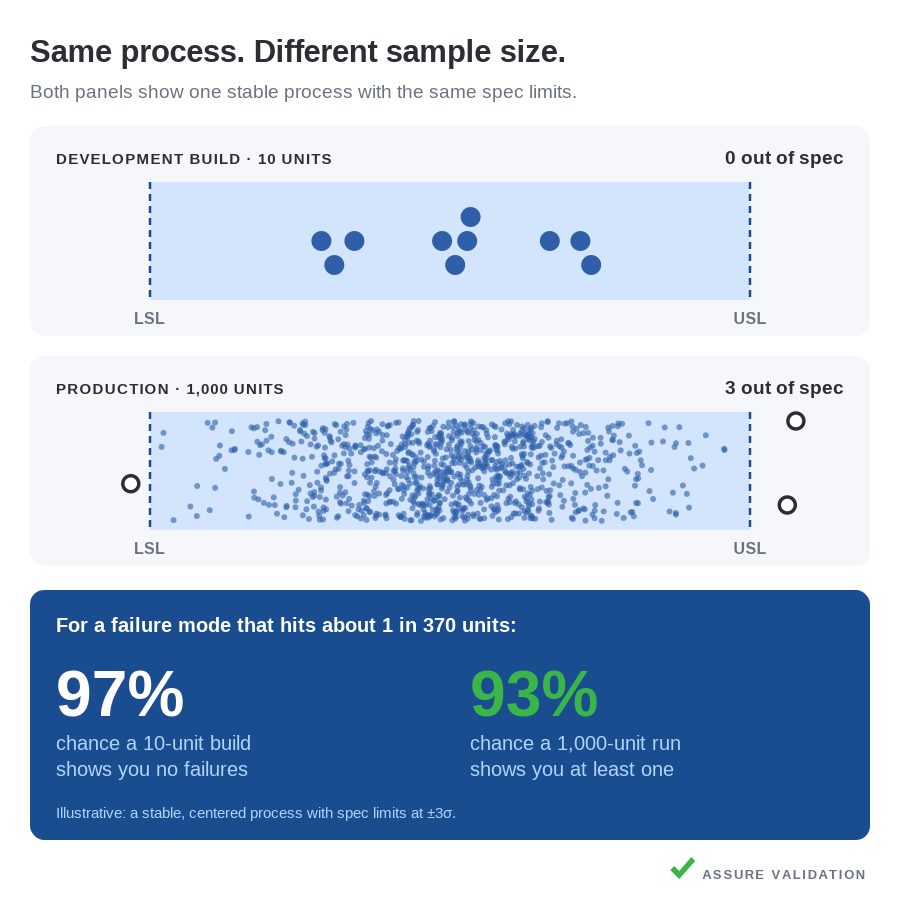
By the time you find this, you’re not fixing it on your timeline. You’re fixing it while orders back up, your CAPA log fills with the same root cause wearing different symptoms, and your best engineers get pulled off the next NPI program to fight this fire.
I’ve seen what that looks like. Shortly after a new product launch, a bond that showed no issues during development started failing on every unit. On paper, the process hadn’t changed. The technician who built the development units, and trained the production operators, had left the company. With no one to compare techniques against, the team had to start from scratch.
A full root cause investigation followed. We didn’t know what the process really looked like or what might have changed, so we had to check everything. “Apply more glue” wasn’t a workable fix – too much glue overflows onto a functional component and creates a different reject. We looked at the test method, the equipment, the materials, the process itself. A full 6M investigation (man, machine, material, method, measurement, mother nature) for what was supposed to be a simple bonding process. All the while, we weren’t building, and orders were backing up.
Most of it came back clean. A fresh batch of glue performed the same as the properly stored batch on the line. A different surface finish made no difference. Different inspectors got the same results on the same parts. Conditions on the floor hadn’t changed.
What didn’t come back clean was how the process ran. The UV light gun was an older unit that measured low in production use, and it most likely had never been at full intensity. Development builds had compensated for it by increasing the cure time and holding the gun close to the parts. And the glue-application step in the work instruction was text only, with no visuals and no amount of glue specified.
None of that mattered at development volume. The process worked, and it moved into production as it was. Nobody had stopped to ask what it depended on.
What didn’t come back clean: a UV light source reading low in production use, and a glue-application step that lived in a technician’s head instead of the work instruction – text only, no visuals, no amount of glue specified.
The table below shows what we checked, what we ruled out, and what we changed. In total, it took one full month to complete the investigation, develop the process and a production test method, perform the process validation, and update all the paperwork so that production could start again.
Process Development Under Pressure: Root Cause Investigation for Bond Failures
| Category | What we found | What we did |
|---|---|---|
| Man | The production operator was trained and qualified by the technician who built the development units. That technician had left the company, so a hands-on comparison of assembly techniques wasn't possible. | Addressed through the updated work instruction (see Method). |
| Machine | Same equipment as development builds. The UV light gun, an older unit, measured low in production use. Most likely it had always run that way, and development builds compensated by increasing the cure time and holding the gun close to the parts. | Ran process validation (IQ/OQ/PQ) to qualify a higher-intensity UV light source for production use. |
| Material | Glue was poured into an open dish and swabbed onto parts, leaving UV glue exposed to ambient light, with potential for degradation. One part had also changed to a smoother surface finish, with potential for reduced adhesion. | Compared a fresh batch of glue to the properly stored batch on the line, and smoother to rougher surface finishes. No difference in either, so both were ruled out. Switched from dish-and-swab to applying glue directly from a light-proof bottle with an opaque black dispense tip, capped when not in use. Light exposure wasn't formally tested, but removing it likely reduced degradation. Added a check of the glue's expiration date before each day's production. |
| Method | No change to the written process instruction. But the glue application step was never clearly defined: text only, no visuals, no amount of glue specified. | Rewrote the work instruction with an initial tack-down step followed by a full-cure step using the higher-intensity light. Added visual aids and clarifying detail for glue application. |
| Measurement | Same inspection method as development builds. The tactile inspection method carried some subjectivity. | Re-trained inspectors and had parts from the same nonconforming lot inspected by different operators. No difference in results, so ruled out. Identified the test method as an essential improvement for objectively comparing process changes, and developed a production tensile method on an Instron UTM, adapted from the development benchtop method, including a new fixture. |
| Mother Nature | No change in temperature or humidity. | Ruled out. No further action. |
One month. Every step in it – characterizing the process, developing a production test method, validating, updating the paperwork – is work that belongs on the pre-launch schedule. Done before launch, it’s a planned line item. Done after, it’s a line-down emergency.
Pitfall 2: You optimized for speed to market, not speed to scale.
“We’ll figure it out later” is not a plan. It’s a bet that the team fighting today’s fire will have the bandwidth, budget, and organizational patience to also build tomorrow’s process. It rarely works out that way, and the reason is structural. Speed to market is won by removing steps. Speed to scale is won by adding controls.
Teams that optimize hard for the first often make the second harder. Skip a process characterization study to hit a launch date, and nobody has the capability data to know where the process breaks down once volume doubles.
That bet usually comes due at the worst time: right when demand is proving the product works, and the business is least willing to slow down and admit the process can’t keep up with the demand its own success created.
One classic version of this: the new product builds on an existing legacy product. The team assumes only the parts of the design that changed need close attention and process development. The legacy product works fine, so there’s no reason to revisit how it’s built. The process development timeline gets compressed. It sounds reasonable.
Reasonable isn’t the same as true. On one program I led, the legacy build process had several undocumented details that a few experienced operators had been quietly filling in. When new operators started building during OQ and PQ, the failures started. The schedule was already under pressure, and what followed was more process development on a compressed timeline, repeat validation builds and testing, and high scrap rates on the first production builds. We couldn’t even reproduce the performance of the earlier development builds. The operators who built them couldn’t fully reproduce what they’d done.
Speed to market and speed to scale are different problems with different solutions. A plan that only solves for the first sets up the second to fail in public – in front of your customers, your investors, and your auditors.
Pitfall 3: You're inspecting everything because you validated nothing.
A lot of teams treat 100% verification as the safe choice. It isn’t. It’s the expensive one, and it’s a symptom, not a strategy.
Here’s the mechanism. Without validation data, you don’t know which process inputs drive your outputs, so every unit looks like a risk and 100% inspection becomes the only available safety net. Every operator hour spent inspecting is an hour not spent building. Every inspection station is a bottleneck the line is designed around instead of engineered past. And every escape that slips through gets treated as a one-off, when it’s really a predictable outcome of a process nobody characterized.
A validated process flips that. Measurement system analysis (Gauge R&R) tells you whether your inspection method itself is trustworthy before you even look at the process. Process capability studies tell you how much natural variation you have and whether your spec limits have real margin or none at all. Process characterization tells you which two or three inputs, not fifteen, are driving your defect rate. A statistical DOE gives you the deepest process understanding, but it takes real time and expertise. When commercialization timelines are tight, focused one-factor-at-a-time studies can be the more practical way to meet your development goals. Once you know that, sampling plans can replace 100% inspection, because the data supports it. That’s not a paperwork exercise. It’s the difference between a floor that’s guessing and a floor that knows.
Early in my career, I supported a validation project where QC was 100% inspecting six CTQ dimensions on every part, for a product that rarely showed dimensional failures. I gathered and analyzed the data to build the justification for a sampled AQL inspection plan. The process proved highly capable. The sampled plan went in, cutting QC inspection time by 50% with no impact on product quality.
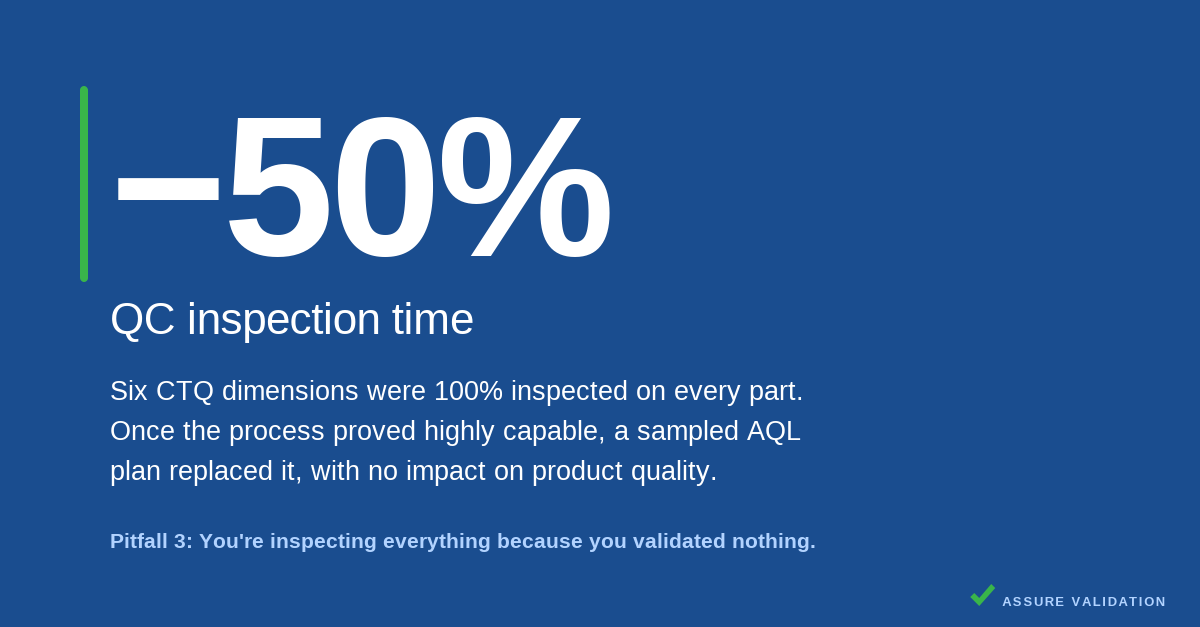
None of this means every check goes away. Some features will always earn 100% inspection. The point is that it should be a decision backed by data, not a default.
If your quality plan is “inspect everything,” you don’t have a controlled process. You have an expensive workaround for not having one.
Pitfall 4: You assumed your best operator would always be there.
Somewhere in every commercialization plan, there’s an unstated assumption: the techs just know how to build it. Work instructions get written to satisfy an auditor’s checklist – step numbers, signature lines, a few photos – not to transfer the knowledge someone would need to do the job without a trainer standing next to them.
That assumption stays invisible right up until it isn’t. Training a new operator against vague instructions means they learn tribal knowledge from whoever’s willing to teach it – inconsistently, incompletely, and only as fast as someone can pull them away from their other responsibilities. Small ambiguities that an experienced operator resolves without thinking – how much pressure “firm but gentle” means, what “until it feels seated” is supposed to feel like, how much is “excessive” or “insufficient” – become real variation the moment a new hire has to guess.
And if the person who knows how to do it leaves? That knowledge walks out the door on their last day, with no transition period built in because nobody planned for one. What you thought was a controlled process was one person’s experience and judgment, undocumented. The first build without them is the moment you find out exactly how undocumented it was.
You’ve already seen what that looks like. It’s the bond that failed on every unit after the technician who built the development units left (Pitfall 1). It’s the legacy process that only worked because a few experienced operators were quietly filling in the gaps (Pitfall 2). Both surfaced the hard way: after the person who knew was gone, or when new hands started building.
Here’s what it looks like when you catch it early.
During development on an NPI project I led, operators repeatedly told us that one bonding process couldn’t be performed as written. They could explain how the geometry of the parts and the viscosity of the glue prevented the bond from being made the way the instruction said. What they couldn’t easily do was turn their “as needed” description of glue application into something reproducible that we could validate and train other operators to. And because the bond was formed under a microscope, watching over their shoulders and taking notes got me nowhere.
Just before we were scheduled to move into process validation, I changed the question. I stopped trying to prescribe a process and asked one of the SMEs to explain, in extreme detail, what she saw as she formed the bond and how she could tell when enough glue had been applied.
“As needed” turned out not to mean there was no repeatable process. The process wasn’t based on a set number of gluing and UV curing cycles, as we had assumed. It was based entirely on visual cues that could only be seen while building under the microscope. Once the glue reached a defined edge, that was the cue to UV cure, rotate the part, and apply glue again, repeating until the bond was complete.
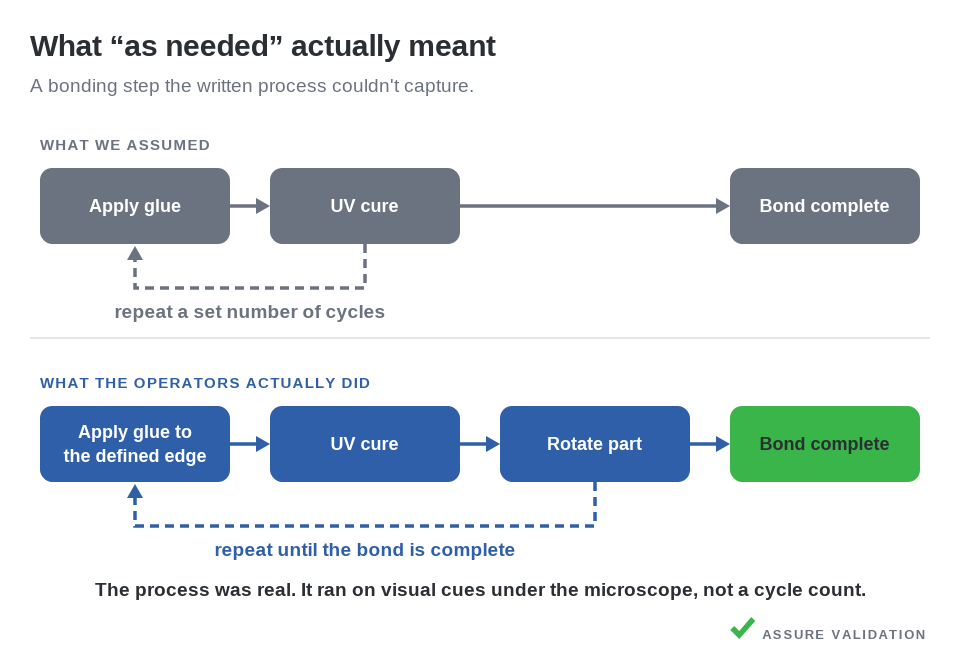
Once we knew what the operators were doing, the rest of process development came much easier. We wrote the instruction around the visual cues, not a cycle count. We added a timed UV tack-down step and a longer final cure to make sure the glue was fully cured and the process was consistent from operator to operator. That’s the process we validated. Had we moved into validation on the process as written, we would have validated something no operator could actually perform.
It sounds like a simple communication issue. It isn’t. Bridging the gap between the person building the product and the person writing the instructions takes time, patience, and attention to detail – the first things to slip when a launch deadline is closing in and the people who know how to do it are just making it work.
The pattern underneath all four
None of these are four separate problems. They’re the same problem, wearing four different outfits: commercialization plans that separate manufacturing from design instead of building them together.
You can’t validate a process you don’t understand. You can’t scale a process you never stress-tested. You can’t inspect quality into a product. You can’t write real work instructions for a process nobody – not even the person who knows how to do it – can explain clearly and consistently.
Every one of these pitfalls traces back to manufacturing being brought in after the decisions were already made. Nobody sets out to do it this way. Launch pressure does it for them. The chaos isn’t random. It’s the way the system works.
The fix isn’t more urgency at launch. It’s bringing manufacturing into the room before design freeze, so the process you validate is one you understand, built by people who were there when the design decisions were made.
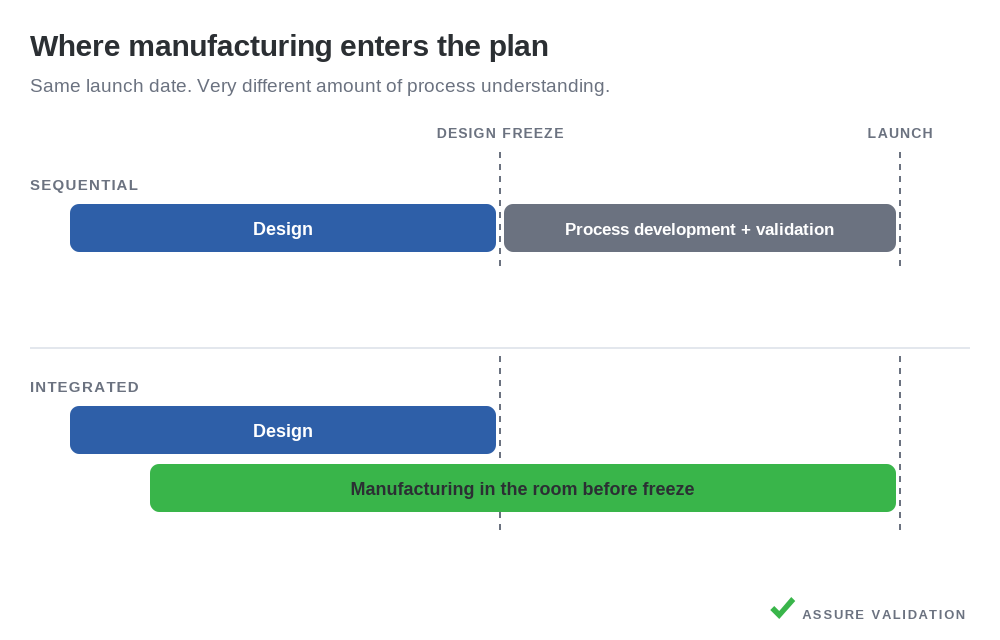
This is the work I do. Assure Validation is an independent consultancy specializing in Process Validation (IQ/OQ/PQ) and Test Method Validation for medical device companies scaling into commercial production, and I lead every engagement myself. The goal is the integrated timeline above: process understanding built before design freeze, so validation confirms the process instead of discovering what it does. I work remotely with US manufacturers, and on site at mainland European facilities.
If any of this sounds like the program you’re running right now, let’s talk before it becomes the program you’re firefighting.